Thousands of scenarios. One defensible estimate. Integrated probabilistic cost and schedule risk analysis for highway construction, built on NHI 134205 principles.
Identify risks, quantify their impact, and measure the value of your mitigation program
Already own CASTR? Renew →
CASTR automates the NHI Course 134205 methodology, bringing rigorous probabilistic analysis to every project team.
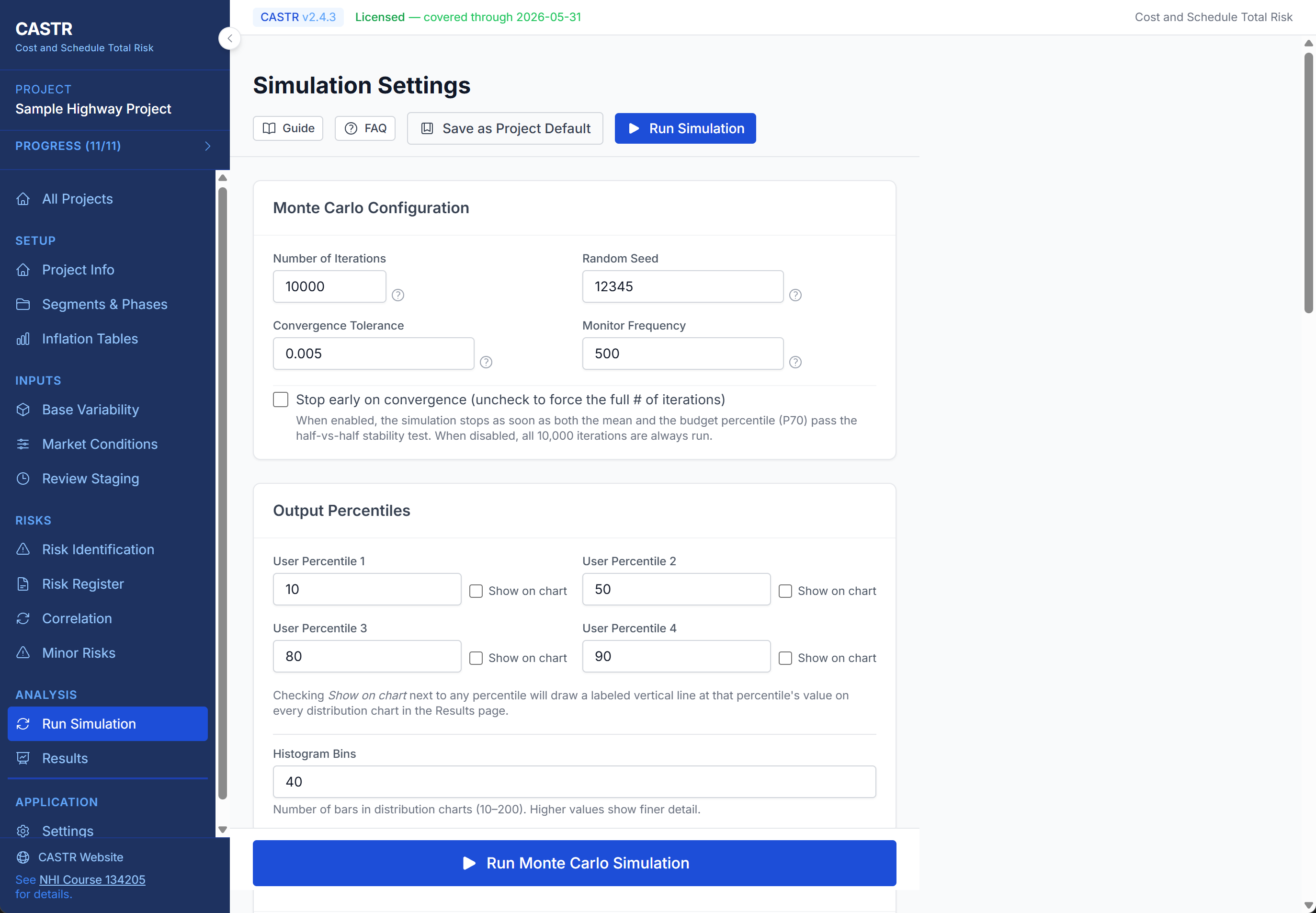
Run 100 to 100,000 iterations with convergence-based early termination, reproducible seed control, and half-vs-half stability testing on mean and budget percentile.
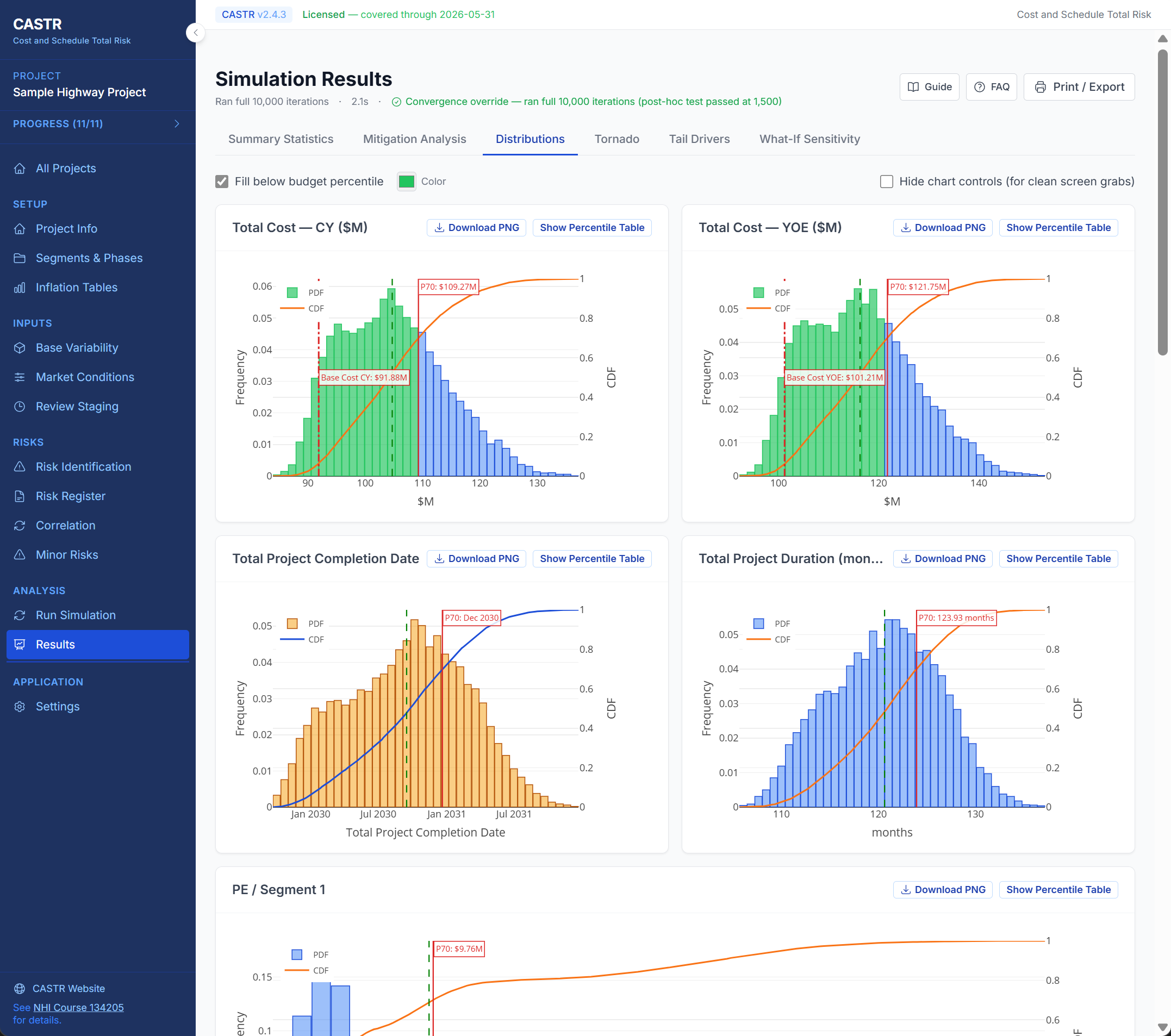
Interactive histogram + CDF overlay for total cost (CY and YOE), duration, and project completion date. Configurable bin counts, labeled percentile lines, dynamic bar coloring around the budget cutoff, and 300 DPI PNG download.
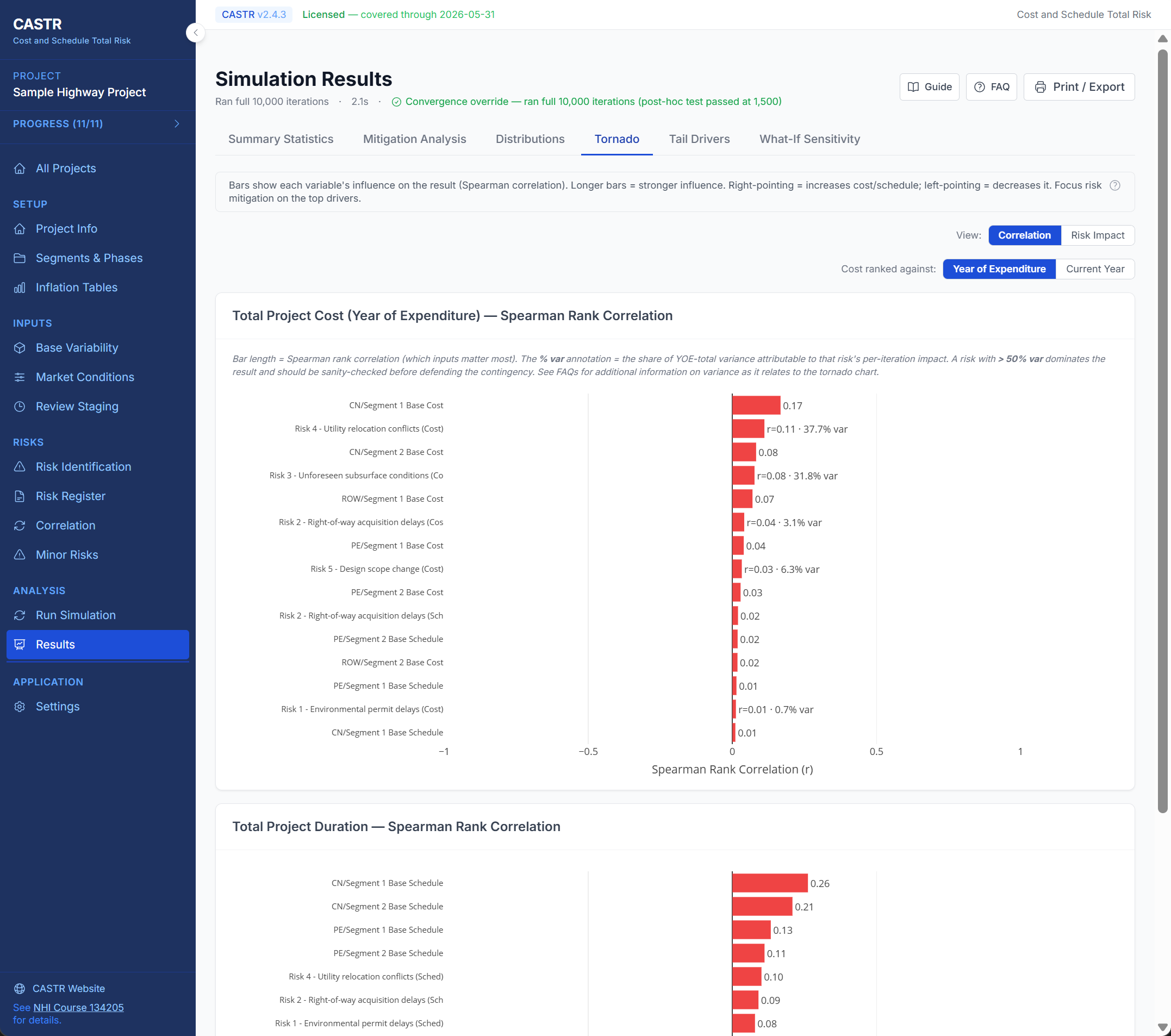
Spearman rank correlation tornado charts with variance share annotation. Risk Impact mode shows bar range, mode, and EV markers. Toggle EV vs. variance share sorting across cost CY, cost YOE, and schedule views.
Understand which risks drive extreme outcomes with fire rate comparison, excess contribution metrics, and plain-language interpretations.
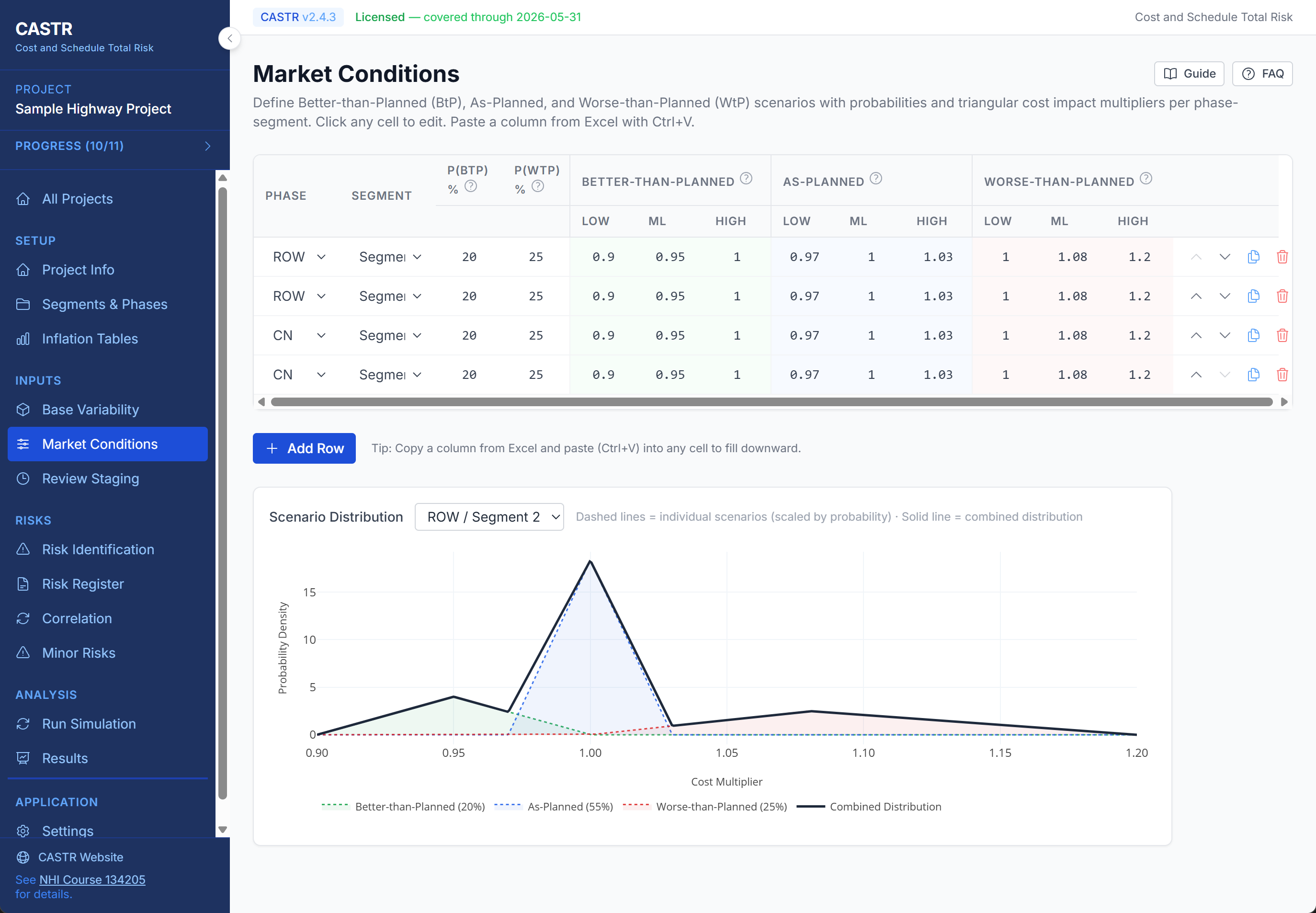
Model Better-Than-Planned, As-Planned, and Worse-Than-Planned market scenarios with probability-weighted cost multipliers.
Define cost-cost, schedule-schedule, and cost-schedule cross-pair correlations using a Gaussian copula. Automatic positive-semi-definite matrix repair when user entries are inconsistent, with an achieved-vs-requested correlation report.
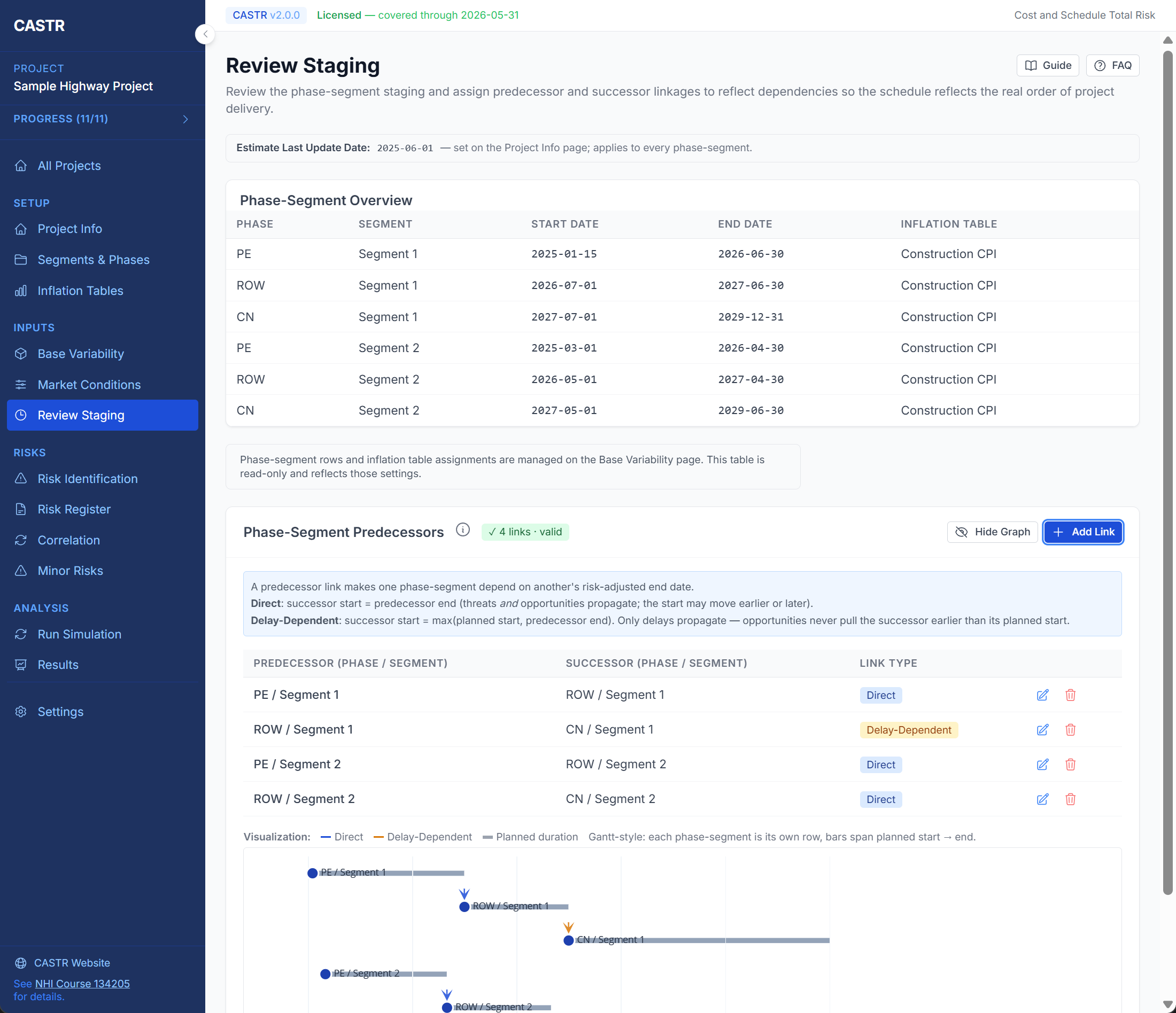
Review phase-segment staging and assign predecessor/successor linkages with Direct or Delay-Dependent rules so the schedule reflects the real order of project delivery. Convert current-year costs to year-of-expenditure dollars with customizable inflation tables.
Comprehensive risk register with customizable column presets (Brief, Standard, Full, Custom), row locking, MIT toggle, status tracking (Active/Inactive/Closed), orphan detection, and auto-sync from Risk Identification.
Import risks from Excel templates with preview-before-commit and validation. Export risk registers to CSV/Excel. Generate Word (.docx) reports with embedded charts. Backup/restore complete projects with versioned manifests.
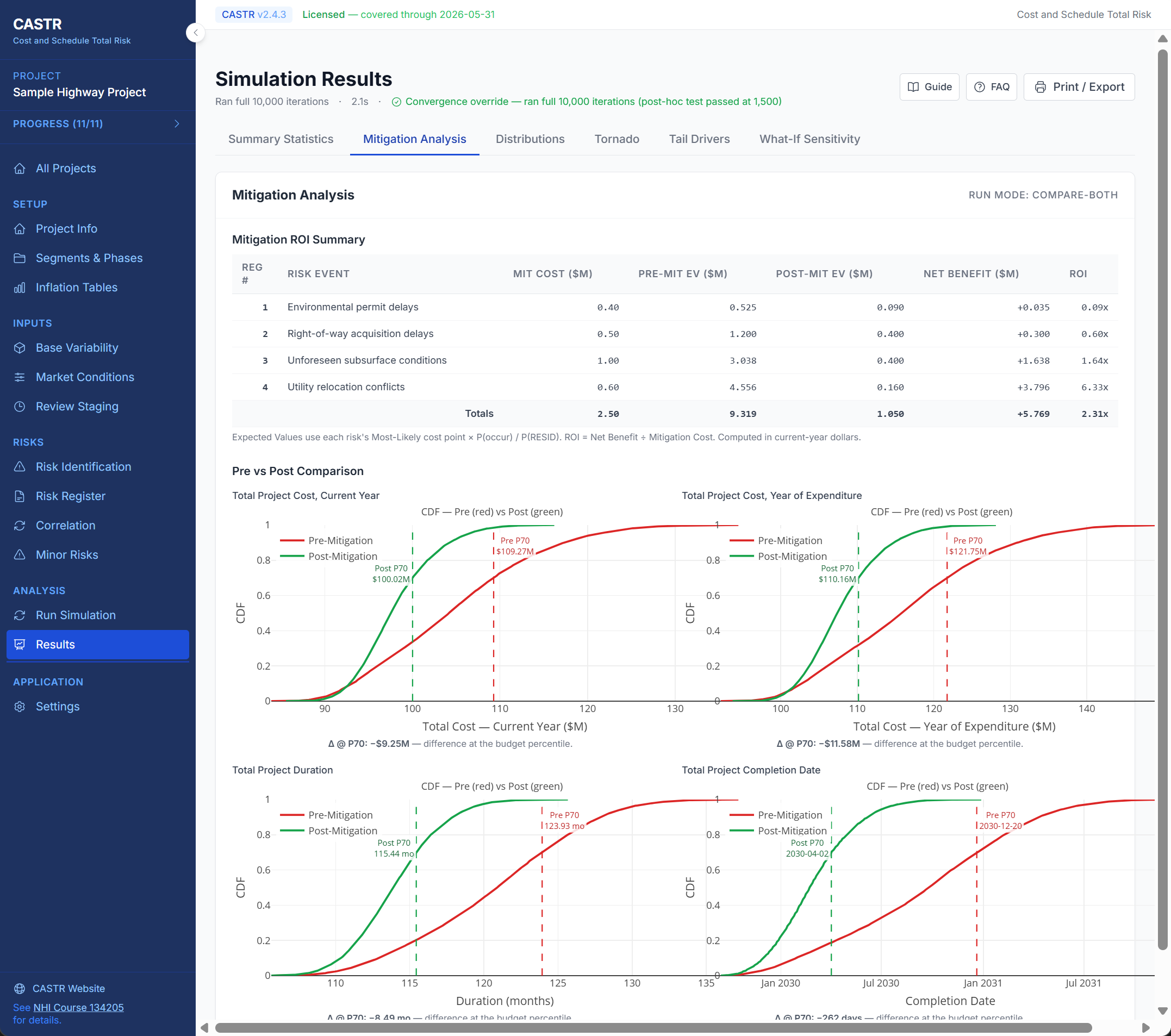
Full risk response workflow (Accept/Mitigate/Avoid/Transfer) with mitigation cost, owner, due date, and stale-date warnings. Pre- vs. post-mitigation simulation with overlay charts and ROI table in both CY and YOE-by-scenario views.
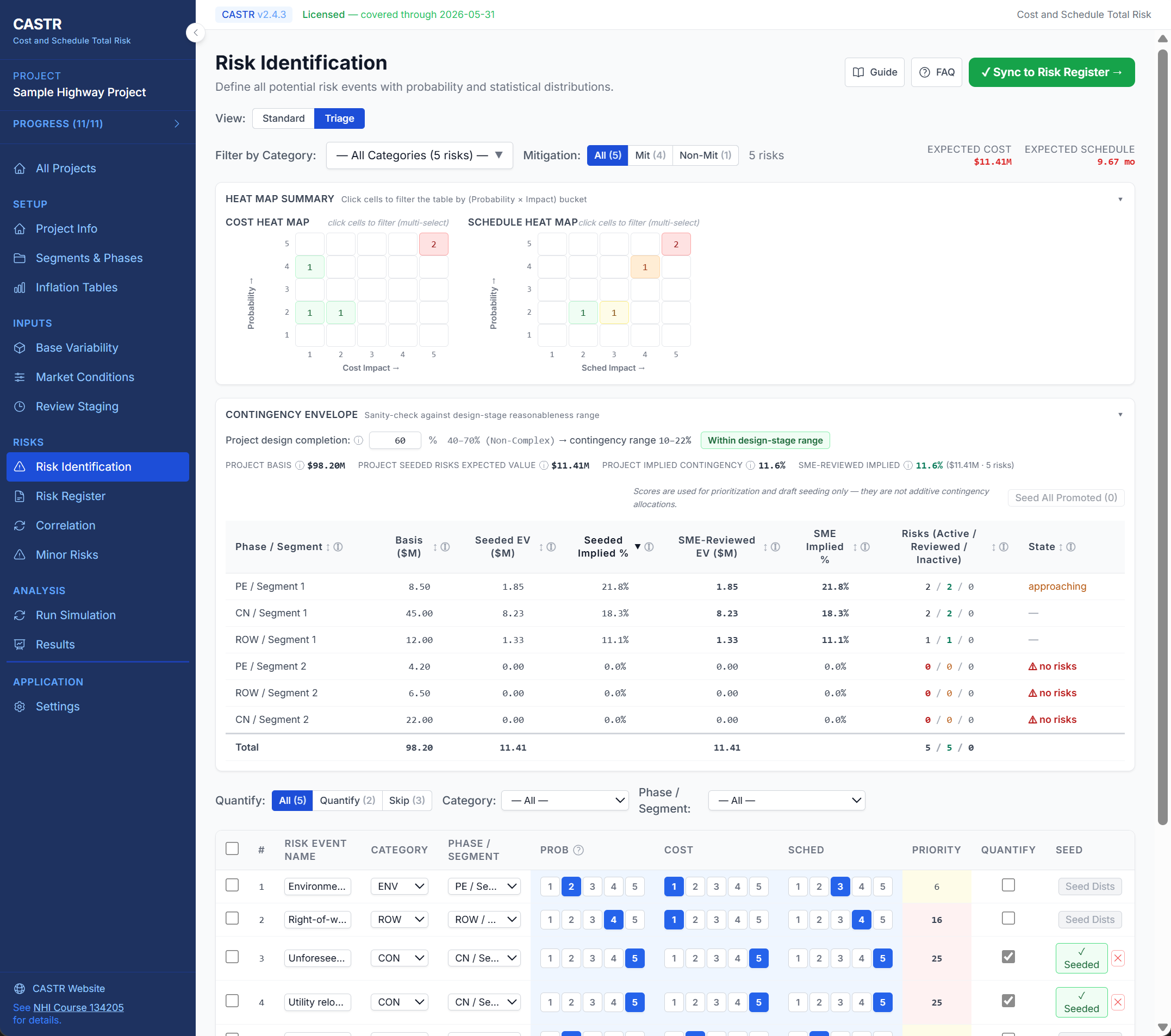
Score risks 1–5 for probability, cost, and schedule impact. Two 5×5 heat maps with click-to-filter cells. Seed button auto-generates Triangular distributions from triage scores. Contingency Envelope card benchmarks against AASHTO/design-stage bands per project complexity.
Ship with ~100 pre-built highway construction risks organized by category. Drop risks into any project in seconds and customize from there.
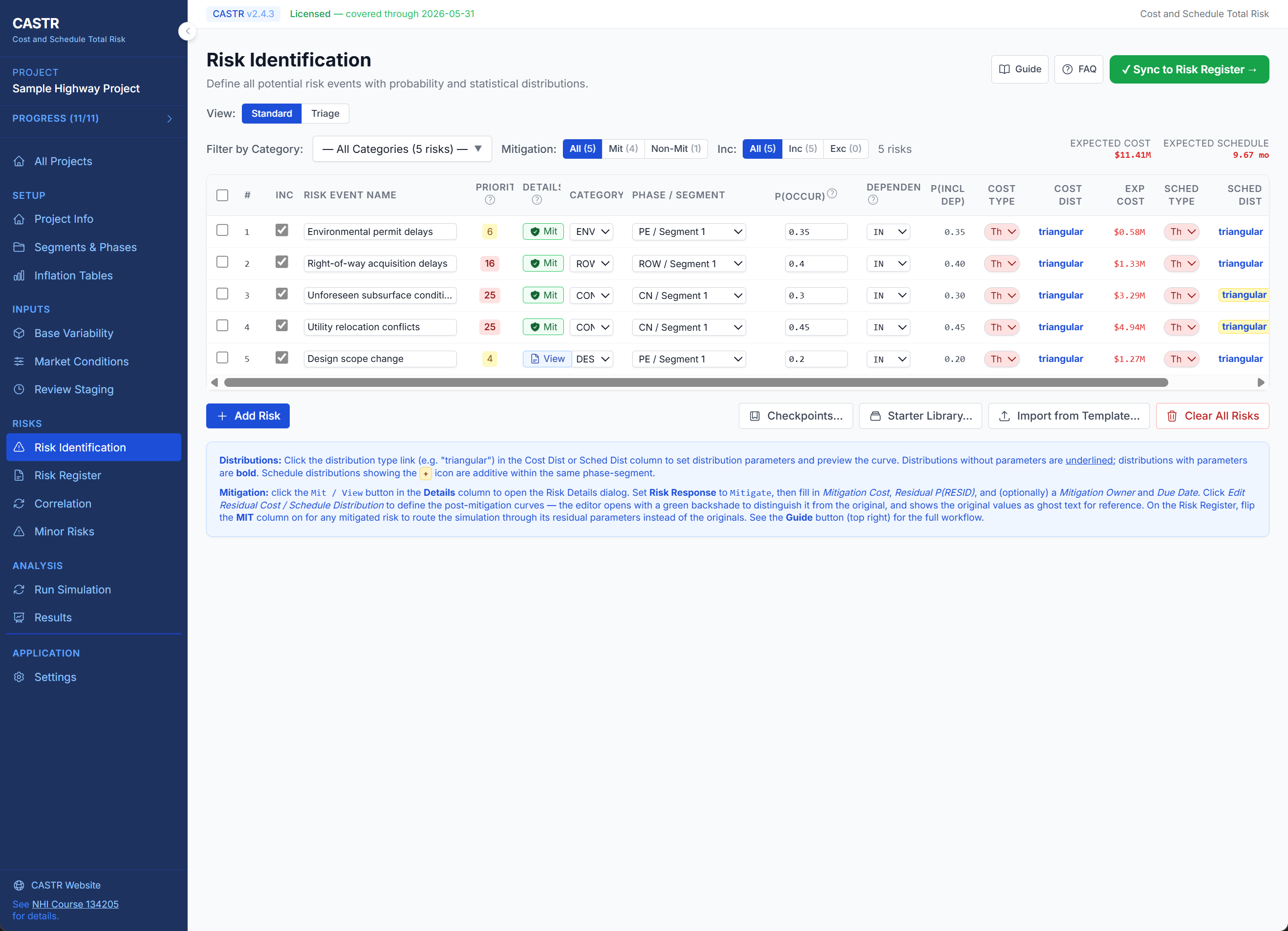
Triangular, BetaPERT, Uniform, Normal, and Constant distributions with parameter validation and live PDF/CDF preview. Model risk dependencies as mutually inclusive, mutually exclusive, or project-wide with auto-computed effective probability.
Choose Percentile of Sum (PoS, NHI-134205 default), Sum of Phase-Segment Percentiles (SoPSP), or Sum of Segment Percentiles (SoSP). Reconstructed distribution charts reconcile visually with the chosen method.
Run the same simulation across multiple inflation deltas (e.g., -3%, baseline, +5%) using cached random draws so all scenarios are bit-for-bit comparable. Sensitivity curve chart for inflation-delta extrapolation.
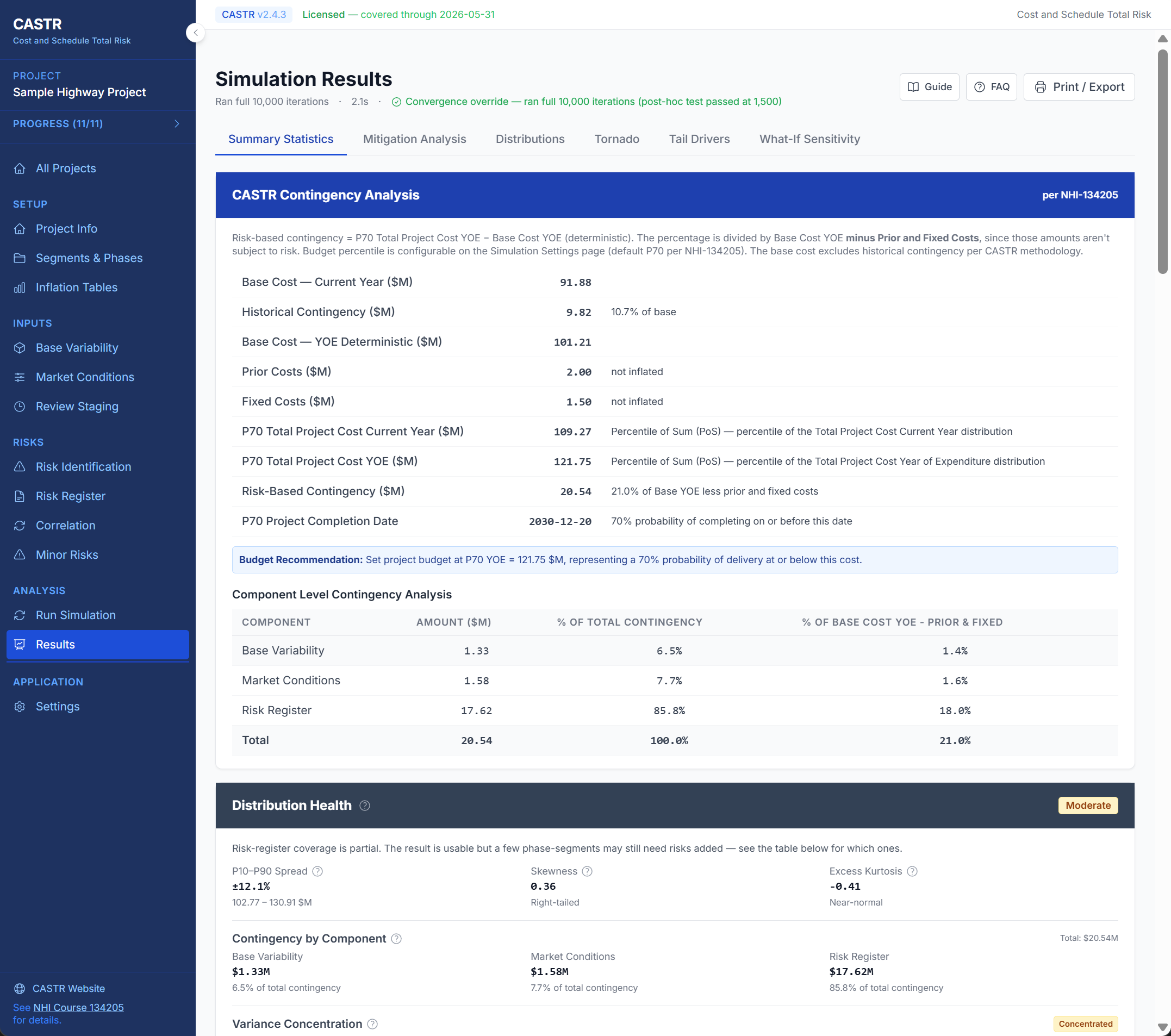
Coverage-driven traffic light, P10–P90 spread, skewness, excess kurtosis, variance concentration (Dominated/Concentrated/Broadly sourced), and component analysis decomposing contingency into Base Variability, Market Conditions, and Risk Register contributions.
Convergence diagnostics saved with every run. Achieved correlation report vs. requested coefficients. Full run history with settings snapshots. Stale-results banner when inputs change after the last simulation. Pre-run validation gate.
Tailor cost and schedule scoring tables plus contingency envelope bands to match your agency's standards. Scaling factors let you bulk-adjust all Low/Mode/High cells at once.
Multi-layer guidance system: page-level guides, contextual FAQ panels, tooltips, and a progress checklist. Pre-run validation catches gaps before you simulate.
Save named snapshots during iterative risk workshop sessions. Auto-undo on destructive operations lets you explore freely without fear of losing work.
Model low-impact risks as single expected-value amounts (impact × likelihood) added deterministically each iteration, keeping the risk register focused on what matters most.
Automatic gap detection in market condition scenarios highlights probability gaps between BTP/AP/WTP ranges and flags configuration issues before they affect results.
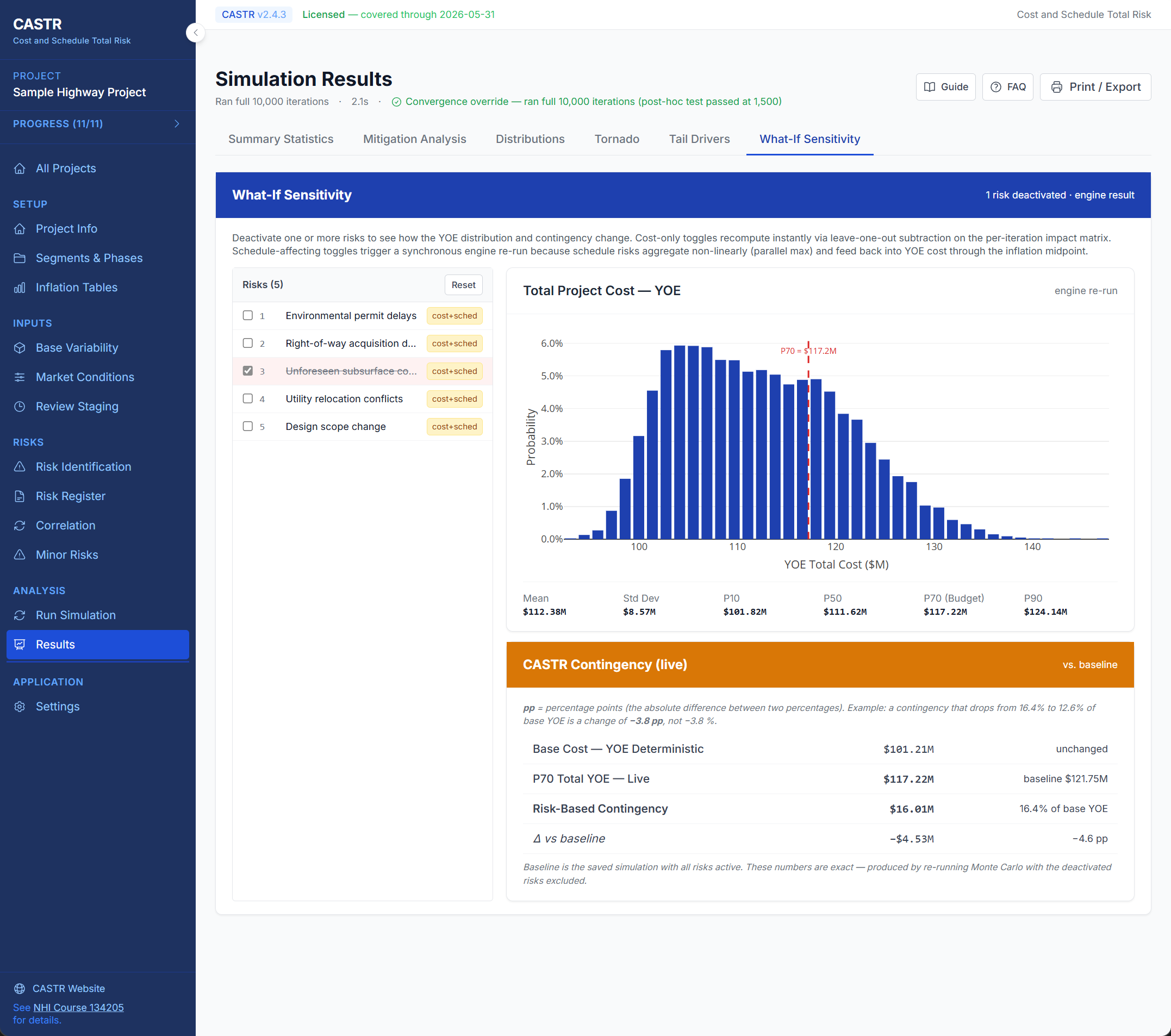
Deactivate risks and instantly see how the YOE distribution and contingency shift using a hybrid recompute engine — cost-only changes resolve client-side via a leave-one-out impact matrix; schedule-affecting changes trigger a synchronous engine re-run.
Word (.docx) report generation with embedded charts at presentation-friendly font sizes. 300 DPI PNG chart downloads for sharp Office insertion. Print-to-PDF with scenario-aware section duplication. CSV/Excel risk register export.
CASTR is a direct implementation of the risk-based estimating methodology taught in Probabilistic Risk-Based Estimating (PRBE) for Highway Project Cost and Schedule (FHWA-NHI-134205).
If your agency follows the NHI methodology, CASTR automates it end to end — from base variability and market conditions through risk identification, Monte Carlo simulation, and budget-percentile contingency calculation. If your agency uses a different standard, every scoring table and envelope band is fully customizable.
Haven't taken the course? Register for NHI Course 134205 for free on the NHI website.
Set up segments, phases, and cost categories that match your project scope. Define risk categories (ENV, CON, DES, UTIL, ROW) for organized tracking.
Input cost and schedule data with variability ranges. Model market conditions (BTP/AP/WTP), assign inflation tables for YOE conversion, and review staging to define phase-segment dependencies.
Score risks in workshop-style triage sessions, review heat maps, seed starter distributions, then refine with the full distribution editor.
Run Monte Carlo analysis, review tornado charts and tail drivers, define mitigation actions, and compare pre- vs. post-mitigation outcomes with ROI tracking.
CASTR turns risk analysis into actionable project intelligence. Identify what threatens your project, quantify how much it matters, and measure the value of your response.
Start with the Starter Risk Library (~100 highway construction risks) or import from Excel. Triage scoring workshops surface the most critical risks fast.
Seed starter distributions from triage scores in one click, then refine with Triangular, BetaPERT, Uniform, Normal, or Constant distributions. Define correlations and market conditions for realistic modeling.
Tornado charts and tail driver analysis show which risks drive cost and schedule outcomes. Heat maps highlight where portfolio risk concentrates so the team knows where to focus.
Define mitigation actions with residual probability and impact. Run Compare-Both mode to overlay pre/post CDF curves and see the ROI of every mitigation dollar.
A modern, browser-based interface that's powerful yet intuitive. All data stays local on your machine.
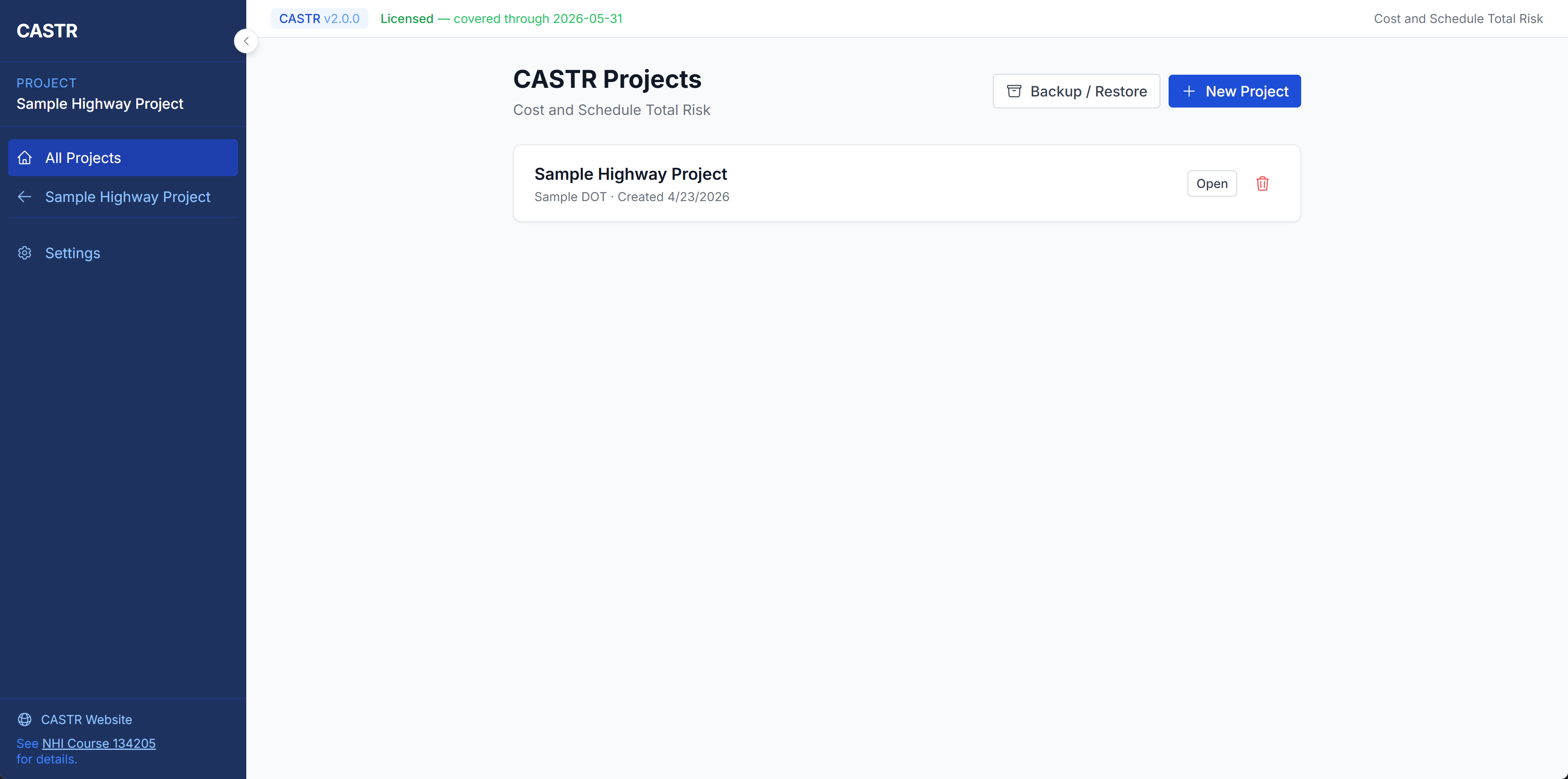
Organize multiple projects with an intuitive dashboard. Create, duplicate, and manage projects with full backup and restore capability.
Define risk events with five distribution shapes, dependency types, and detailed documentation. Standard and Triage views on the same data for full edit or rapid 1–5 scoring workflows.
Get clear, defensible budget recommendations with NHI-134205 contingency breakout, inflation sensitivity scenarios, and component analysis.
Rapidly score risks in workshop sessions using a 1–5 probability/cost/schedule framework. Two 5×5 heat maps give an instant visual snapshot of where portfolio risk concentrates, so the team can focus discussion on the highest-priority items.
Pinpoint exactly which risks matter most with tornado charts and tail driver analysis, so teams can focus mitigation where it counts.
Go beyond risk identification. Define mitigation actions for each risk, model the residual probability and impact, then run pre- vs. post-mitigation simulations to see exactly how much your mitigation program is worth.
Define how phase-segments relate to each other with predecessor/successor linkages. Choose Direct or Delay-Dependent rules to control how schedule changes propagate through the project network.
Model Better-Than-Planned, As-Planned, and Worse-Than-Planned market scenarios per phase-segment. Built-in gap detection warns you when scenario ranges don't overlap, preventing probability dead zones in the simulation.
Deactivate one or more risks and instantly re-run the simulation to see exactly how the YOE distribution and contingency shift. Understand each risk's true dollar contribution to the budget recommendation.
Fine-tune the Monte Carlo engine with configurable iteration counts (100–100,000), convergence tolerance, and random seed control. Three run modes let you analyze pre-mitigation, post-mitigation, or compare both side by side.
Start with a free 90-day trial — includes a sample project plus 2 additional projects you can create, with full functionality. Purchase a seat license to unlock unlimited projects. Your license never expires — the app keeps working forever.
Perpetual use of any CASTR build released in your first 12 months. The app keeps working forever on versions you're entitled to.
Free 90-day trial included with download. Includes 1 sample project + 2 additional projects. Unlimited projects with a license.
Already a customer? Extend your upgrade coverage another 12 months for half price. Renew anytime — there's no lapse penalty.
Your Machine ID is visible in the top bar of the app once it is licensed.
Everything you need to know about CASTR licensing.
A perpetual license to any CASTR build released within the 12 months after your purchase. The app you install never stops working — there's no subscription, no phone-home, no auto-renew.
Your installed CASTR keeps working forever. If we release a newer version and you want it, renew for TBD to get another 12-month upgrade window. If you don't care about new versions, do nothing — your current build is yours.
Only access to newer releases. No features get disabled, no projects become inaccessible.
Licenses are bound to a Machine ID. Email support and we'll reissue at no charge.
Yes — contact us within 30 days if CASTR isn't working for you.
No. Renewals are optional and manual. You control when (or whether) to extend.
No. Customers who purchased before the upgrade-window model was introduced keep lifetime access to all future versions — no renewal needed, ever.
CASTR was created by Michael Smith following his retirement from the Federal Highway Administration in 2023, where he spent 32 years advancing quantitative risk assessment for highway infrastructure projects.
The application implements the methodology taught in the National Highway Institute (NHI) Course 134205, making rigorous probabilistic cost and schedule estimating accessible to project teams without requiring specialized statistical software.
CASTR is a standalone desktop application that runs entirely on your local machine. It launches a local server and opens in your web browser, requiring no cloud connectivity or external dependencies. All project data remains on your computer, ensuring complete data privacy and security.
Compatible with Microsoft Windows. Chrome, Edge, or Firefox recommended for the best experience.